


Best Waterproof Phone Pouch for Swimming UK (2026) - What to Actually Look For
Wild swimming in the UK has never been more popular. Open water events, sea swimming clubs, river dips, lido mornings - the number of people taking to natural water has grown substantially over the last few years, and it shows no sign of slowing. And with that growth has come a question that pool swimmers rarely had to ask: what do I do with my phone?
The answer, for most swimmers, is a waterproof phone pouch for swimming. It keeps your phone dry and accessible - clipped to a tow float, worn around your neck, or tucked into a swim cap - and it means you can track your swim, call for help in an emergency, and take photos in and around the water without risking a phone that costs upwards of £800 to replace.
But not all waterproof phone pouches are suitable for swimming. The difference between a pouch that handles poolside splashes and one that can genuinely be submerged is significant - and it's not always clear from the packaging. This guide cuts through the marketing language and tells you exactly what to look for.

Why Swimming Is a Different Challenge From Rain or Splashing
Most waterproof phone pouches on the market are not designed for swimming. They're designed for rain, splashes, and incidental water contact - and there's an important technical distinction between those two categories.
A pouch that protects against rain or spray needs to resist water hitting the outside under relatively low pressure. A pouch designed for swimming needs to resist full hydrostatic pressure - the weight of water pushing against the seal from all directions simultaneously, sustained for the duration of your swim. These are not the same engineering challenge.
The failure point, almost always, is the closure. Most budget waterproof pouches use a standard zip or a double-roll closure that is fine for rain but inadequate for submersion. Under sustained water pressure, a degraded zip lets water in. A roll-top that isn't sealed correctly leaks at the fold. The result is a phone that's wet on the inside of a pouch that looks perfectly intact on the outside.
Saltwater and chlorinated pool water add another layer of risk. Both degrade certain seal materials and coatings over time, and a pouch that worked fine in fresh water may fail sooner in the sea or the pool if it isn't designed and rated for those environments.
The only reliable way to know whether a pouch is genuinely suitable for swimming is to check its IP rating - and to understand what that rating actually means.
Understanding IP Ratings for Swimming Use
IP stands for Ingress Protection. Ratings are defined by the international IEC 60529 standard and provide an independently tested, verifiable measure of protection against both dust and water. Unlike marketing terms like 'waterproof' or 'water-resistant', an IP rating is a specific, quantifiable claim that must be backed by testing.
The rating consists of two digits. The first covers dust protection (6 is the maximum - completely dust-tight). The second covers water protection. For swimming use, here is what the relevant ratings actually mean:
-
IP64: Water resistant for light rain and spray. The entry level of protection in OverBoard's range. Not suitable for swimming.
-
IP65: Foul weather and spray proof - OverBoard's definition for this class. Protects against sustained spray and foul weather conditions. Not suitable for swimming.
-
IP66: Floats and can handle quick submersion - OverBoard's description for this class, used across the backpack and dry bag range. Strong protection against high-pressure jets from all directions. Not rated for sustained submersion at depth.
-
IP67: Submersible to depths of up to 1m / 3ft for 30 minutes - OverBoard's definition for this class. Provides meaningful submersion protection but OverBoard's phone pouches exceed this, carrying a full IP68 rating for greater depth and duration.
-
IP68 - the rating to look for: Submersible to depths of up to 6m / 19ft for 60 minutes - this is OverBoard's own definition for their IP68-rated products, including both waterproof phone pouches. This is the rating you need for confident swimming use in the pool, the sea, or open water.
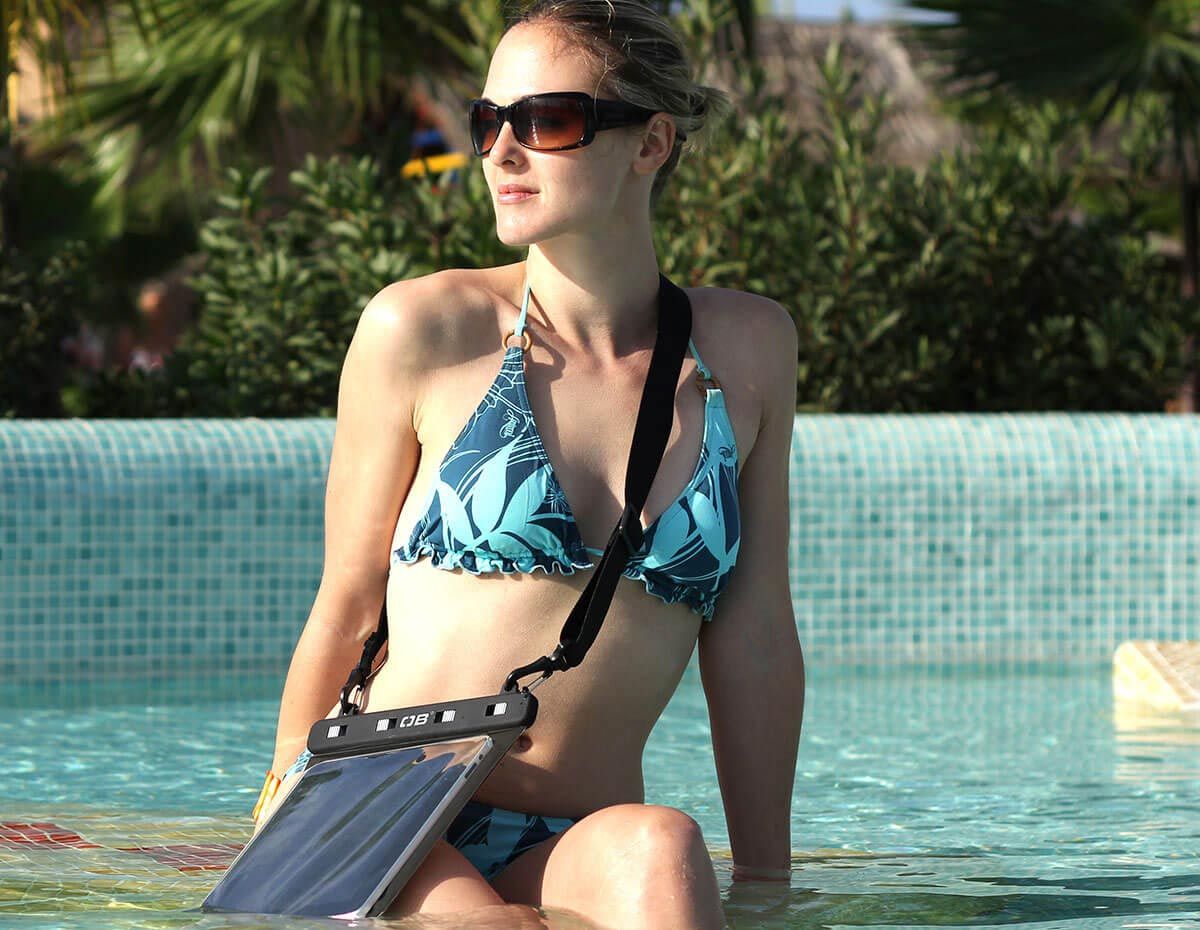
One important nuance: IP ratings are assigned to the product as tested, not to the seal mechanism alone. A pouch rated IP68 has passed the full submersion test as a complete unit - closure, seams, windows, and all. A pouch with no IP rating that claims to be 'waterproof' has made a marketing claim, not a tested one.
Water-Resistant vs IP68 Waterproof: What the Difference Looks Like in Practice
The table below shows what you can and can't do with each type of pouch in a swimming context.
|
Feature |
Water-Resistant Pouch |
IP68 Waterproof Pouch (OverBoard) |
|---|---|---|
|
Pool swimming |
✗ Not suitable |
✓ Fully safe |
|
Open water swimming |
✗ Not suitable |
✓ Fully safe |
|
Submersion depth |
Not tested for submersion |
Up to 6m (19ft) |
|
Submersion duration |
Not tested |
Up to 1 hour |
|
Seal type |
Zip (degrades with use) |
Slide Seal System (registered) |
|
Touchscreen use |
Sometimes |
✓ Above water |
|
Underwater photography |
✗ Not reliable |
✓ Through TPU window |
|
Suitable for saltwater |
✗ Degrades seal |
✓ Rinse with fresh water after |
|
Suitable for chlorine |
✗ Degrades coating |
✓ Rinse with fresh water after |
Why the Seal Type Matters More Than Anything Else
The waterproof rating of any pouch is only as good as its closure. The closure is the only part of the pouch that opens - and therefore the only part that can fail. In swimming conditions, where the seal is under sustained hydrostatic pressure for potentially an hour or more, the quality of that closure mechanism is everything.
Standard zips - even branded 'waterproof' zips - are a mechanical seal that relies on interlocking teeth pressing together under tension. They work well when new and dry. They degrade with salt exposure, UV, and repeated use. Under sustained submersion pressure, a zip that's slightly worn or slightly misaligned will let water in. This is why you see one-star reviews on waterproof pouches that say 'worked perfectly for six months and then my phone got soaked'.
OverBoard's waterproof phone pouches use the registered Slide Seal System - a purpose-designed sliding lock mechanism that doesn't rely on interlocking teeth. To seal it, you insert your phone, expel the air from the top of the pouch, and slide the lock across until it clicks. There are no teeth to misalign, no material to degrade at the join, and no separate flap to lose. When closed correctly, the seal is continuous and watertight to OverBoard’s IP68 rating - submersible to 6m / 19ft for up to 60 minutes. This is what makes the pouch suitable for swimming rather than just rain.
The Lanyard Question: How to Carry Your Phone in the Water
For pool swimming, where your phone is staying on the pool deck or in a swim bag, the lanyard is a secondary consideration. For open water swimming, it's a primary one.
In open water, you are in a moving environment. If your phone is not attached to you and something goes wrong - a wave, a capsize off a kayak, a cramp that breaks your stroke - your phone will separate from you. In a river or the sea, a phone that isn't floating and attached is a phone you're not getting back.
There are three practical ways to carry a waterproof phone pouch in open water:
-
Neck lanyard: The most common method for open water swimmers. The pouch sits on your chest, accessible without stopping your stroke. Works well for shorter swims and for taking photos at the surface.
-
Clipped to a tow float: Many open water swimmers use a tow float or swim buoy for safety. A waterproof pouch can be clipped to the attachment point of the float, keeping the phone accessible but out of the way during the swim itself. This is the preferred method for longer swims where you don't want the weight of the phone on your chest.
-
Wrist strap: Less common but practical for short swims or when taking photos is the primary goal. The wrist attachment means the phone is immediately accessible for photography but can become tiring on longer swims.
Both OverBoard waterproof phone pouch sizes feature a reinforced attachment point at the top of the pouch, designed to take a lanyard or neck cord and hold the weight of a modern smartphone under water pressure without pulling on the seal. Check the individual product page for details of what is supplied with each pouch.
Does It Float? Why This Matters More Than People Realise
A waterproof phone pouch that doesn't float is a significant risk in any water environment. In a pool, a dropped pouch sinks to the bottom - retrievable, but inconvenient. In open water, a dropped pouch that sinks in a river, the sea, or a lake is almost certainly gone.
OverBoard's waterproof phone pouches float when correctly sealed. The sealed design traps air inside the pouch alongside the phone, providing buoyancy. In practice, this means that even if the pouch detaches from a lanyard or tow float, it will remain visible on the surface long enough to retrieve - rather than disappearing into the water column within seconds.
Not all waterproof pouches float. Those that don't typically use heavier materials or have less internal air volume when sealed. If you're swimming in anything other than a pool, floating capability is not a nice-to-have - it's a meaningful safety feature.
Touchscreen Use and Photography - What Actually Works Underwater
One of the most common questions about waterproof phone pouches for swimming is whether you can use the touchscreen underwater. The honest answer is: above the surface, yes - reliably so, when the pouch is correctly sized for your phone. Below the surface, no - and this isn't a limitation of the pouch.
Capacitive touchscreens - used in every modern smartphone - work by detecting the electrical signal from your fingertip. Water conducts electricity. When a phone is submerged, the touchscreen can't distinguish between your finger and the water around it, and it either stops responding or responds erratically. This happens whether the phone is in a pouch or not.
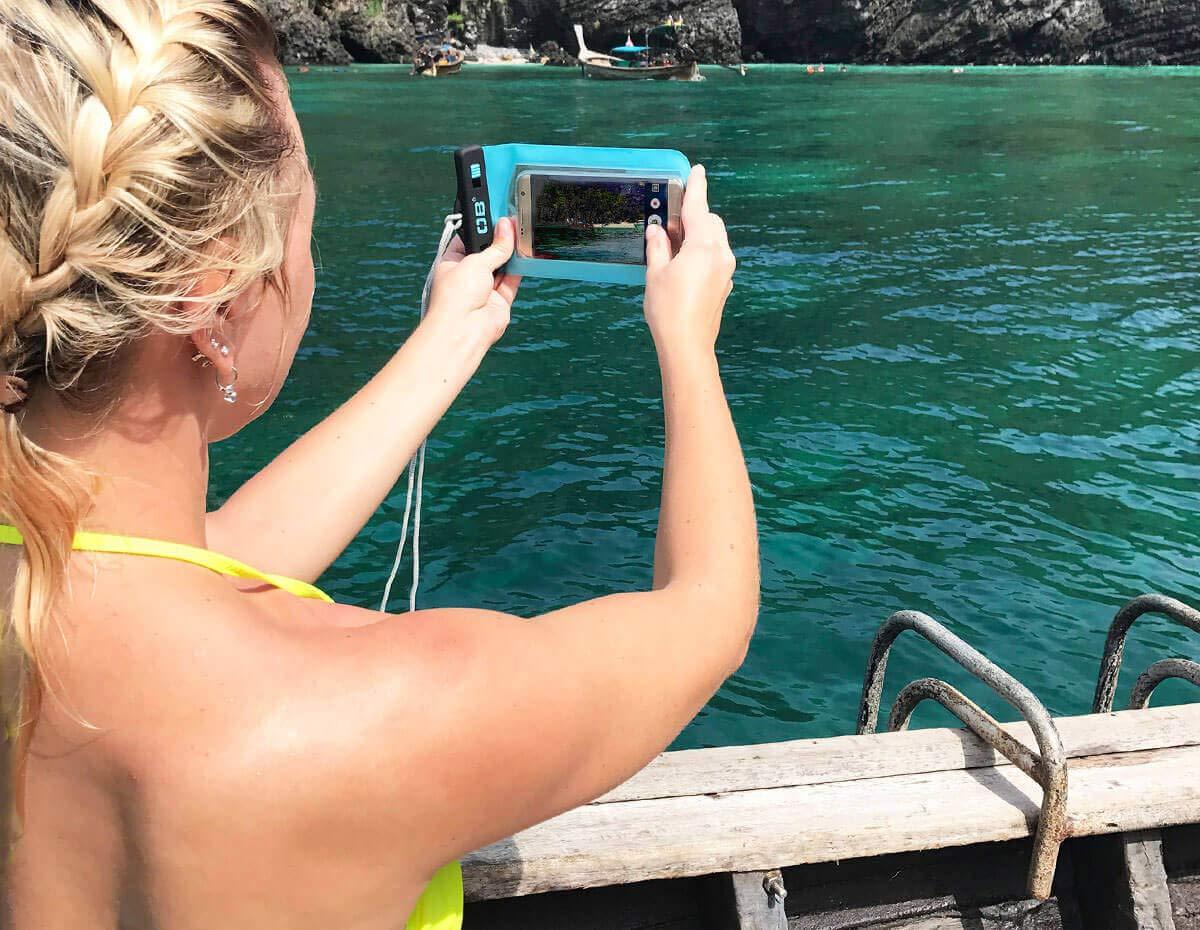
The workaround for underwater photography is the physical volume button. Both iPhone and Android phones allow you to trigger the camera shutter using the volume up or volume down button. Start the camera app before you submerge, frame your shot, and press the volume button through the TPU wall of the pouch. This works consistently and is the standard method used by swimmers and snorkellers worldwide.
Photo quality through the pouch depends primarily on fit. When the correct size pouch is used for your phone - meaning the TPU window sits flush against the camera lens with no air gap - photos are clear and distortion-free. When the pouch is oversized, the window moves independently of the lens, and photos at depth become blurry. Sizing is not just about whether the phone fits - it directly affects the quality of what you capture.
Open Water Swimming vs Pool Swimming - Does the Right Pouch Differ?
The core requirements are the same - IP68 rating, reliable seal, correct size. But there are practical differences worth knowing about.
For pool swimming: chlorine is the main consideration beyond waterproofing itself. Chlorine is corrosive to some seal materials over time. OverBoard's TPU construction and Slide Seal System are chlorine-resistant - rinse the pouch with fresh water after pool use and the seal integrity is maintained. The bigger practical consideration in a pool is what you're doing with the phone during your swim. If it's staying on the poolside, you need protection against splashes and accidental dropping into the water, not sustained submersion. If you're taking it in the water with you - for tracking, music via a waterproof speaker, or photography - you need full IP68 protection.
For open water swimming: additional factors come into play. Saltwater is more corrosive than chlorine over time and more viscous than fresh water, which affects how pressure distributes around the seal. Rinse the pouch thoroughly with fresh water after every sea swim. Temperature also matters - cold open water can affect seal flexibility in cheaper pouches. OverBoard's materials maintain their seal integrity across the range of temperatures you encounter in UK open water swimming, from summer lido swims to winter cold-water dipping.
For wild swimming in rivers and lakes: the practical concern is current and turbulence. A river swim involves directional water pressure that's different from pool or sea swimming. This is where IP68's submersion testing - sustained immersion at depth rather than surface-level splash resistance - gives you genuine confidence. A pouch rated for static submersion only isn't the same as one rated for the turbulent, directional pressure of moving water.
The Swimming Phone Pouch Checklist: What to Look For Before You Buy
Use this checklist when assessing any waterproof phone pouch for swimming use.
|
What to Check |
Why It Matters for Swimming |
|---|---|
|
IP68 rating (not IP64 or IP65) |
IP68 is the highest rating and covers submersion to 6m / 19ft for 60 minutes. IP64 and IP65 protect only against light rain and spray - not swimming. |
|
Slide seal or locking closure |
Zips degrade. A dedicated locking seal mechanism holds under sustained submersion and repeated use. |
|
Lanyard or neck strap included |
Essential for open water swimming. If the pouch isn't attached to you, a capsize or wave can separate you from your phone instantly. |
|
Floats when sealed |
A pouch that floats gives you a recovery window if it detaches in open water. Non-floating pouches sink within seconds. |
|
Clear TPU windows front and rear |
Allows both touchscreen use and photography. Single-window pouches are fine for protection but frustrating to use practically. |
|
Correct size for your phone |
An oversized pouch means the TPU window doesn't sit flush - blurry photos, unresponsive touchscreen, and a compromised seal. |
|
Independent waterproof testing |
Look for third-party IP certification, not just a manufacturer's claim. The two are not the same. |
|
Compatible with your phone's physical buttons |
You'll be using volume buttons to trigger the camera underwater. Make sure they're accessible through the pouch. |
Which OverBoard Pouch Size Is Right for Your Phone?
OverBoard makes waterproof phone pouches in two sizes, both rated IP68 and both suitable for swimming:
The Small Waterproof Phone Pouch - designed for phones up to 5.5 inches screen size. Suitable for iPhone SE (2nd and 3rd generation) and smaller Android handsets. If you have a current flagship smartphone - any iPhone 15, 16, or 17, any Samsung Galaxy S24 or S25, any Google Pixel 8 or 9 - the Small is not the right choice.
The Large Waterproof Phone Pouch - designed for phones up to 6.5 inches screen size. This covers the vast majority of current smartphones. If you have a modern flagship phone, this is almost certainly the one to choose. The slightly larger internal volume also means a more comfortable air pocket when sealed, which contributes to buoyancy in the water.
The fit is worth emphasising in a swimming context because it directly affects both the photography quality and the buoyancy. A correctly sized pouch - where the phone fills the main compartment and the TPU window sits flush against the screen - is both more useful in the water and provides the seal with the internal structure it's designed to work against.
Looking After Your Waterproof Phone Pouch After Swimming
A waterproof phone pouch for swimming is a piece of equipment, and like all equipment, it performs better and lasts longer with basic maintenance.
-
After pool swimming: Rinse the pouch under fresh running water. Pay attention to the seal track - chlorine residue can build up in the groove over time. Dry the pouch fully before storing with the seal open.
-
After sea swimming: Rinse thoroughly with fresh water immediately after use. Saltwater left on or in the seal accelerates material degradation. Open the pouch and rinse the interior too if any moisture has entered.
-
After open water swimming: Check the seal for grit or sand, which can compromise the closure if it works its way into the seal track. Rinse and dry fully before the next use.
-
Periodic seal check: Before any important swim - a race, a long open water event, a holiday where the pouch is doing serious work - test the seal with a piece of tissue paper inside instead of your phone. Submerge for two minutes and check whether the tissue is dry. This costs nothing and gives you real confidence before you trust your phone to it.
OverBoard's Slide Seal System is designed to maintain its integrity across many cycles of use. The 5-year extended warranty reflects the confidence behind that design - but basic maintenance is still worthwhile.
Frequently Asked Questions
Can I use my phone in the swimming pool with a waterproof pouch?
Yes - if the pouch is rated IP68. An IP68 rating means the pouch has been independently tested for submersion beyond 1 metre for extended periods, which covers pool swimming comfortably. OverBoard's waterproof phone pouches carry an IP68 rating - submersible to 6m / 19ft for up to 60 minutes. Pouches rated only IP64, IP65, or IP66 are not suitable for full pool submersion - they protect against rain, spray, and quick submersion respectively, not sustained underwater use.
Can I take photos underwater with a waterproof phone pouch?
Yes. Both OverBoard phone pouch sizes have clear TPU windows front and rear that allow your phone's camera to photograph through them. Photo quality is best when the pouch is correctly sized for your phone - an oversized pouch means the window isn't flush against the lens, which can cause blurring. Use your phone's physical volume buttons to trigger the shutter underwater, as touchscreens don't respond reliably when submerged.
Is a waterproof phone pouch safe for open water swimming?
Yes, provided it carries an IP68 rating and includes a lanyard or secure attachment method. For open water swimming specifically, also check that the pouch floats when sealed - this is a safety consideration if it detaches from your lanyard or tow float in moving water.
How do I use my phone underwater in a waterproof pouch?
Set up your camera app before submerging. Once underwater, use your phone's physical volume up or volume down button to trigger the shutter - this works on both iPhone and Android. The touchscreen won't respond reliably underwater because water interferes with the capacitive sensor, but the physical buttons work consistently through the TPU wall of the pouch.
Will a waterproof phone pouch work in saltwater?
Yes - OverBoard's IP68-rated pouches are suitable for saltwater use. Rinse the pouch thoroughly with fresh water after every sea swim to prevent salt residue building up in the seal track, which can accelerate degradation over time.
Will a waterproof phone pouch work in a chlorinated pool?
Yes. OverBoard's TPU construction and Slide Seal System are chlorine-resistant. Rinse with fresh water after pool use and the seal integrity is maintained. Avoid leaving the pouch sealed with chlorinated water inside for extended periods.
What's the difference between the Small and Large OverBoard phone pouches for swimming?
Both are rated IP68 and both float when sealed. The primary difference is size - the Small fits phones up to 5.5 inches, the Large fits phones up to 6.5 inches. If you have a current flagship smartphone, choose the Large. The Large also has marginally more internal air volume when sealed, which contributes slightly more buoyancy - a minor but real advantage for open water use.
How do I carry a waterproof phone pouch when open water swimming?
The three main methods are: around your neck on a lanyard (most common for general open water swimming), clipped to your tow float (preferred for longer swims where chest weight is a consideration), or on a wrist strap (best for photography-focused swims). For any open water swim, make sure the pouch is attached to you or your float - not just loose in the water.
The Bottom Line
A good waterproof phone pouch for swimming does three things: it keeps your phone genuinely dry under sustained submersion, it stays attached to you in the water, and it lets you use the camera when you want to. The things that determine whether a pouch can deliver all three are the IP68 rating, the seal mechanism, and getting the size right for your specific phone.
Most waterproof pouches on the market meet the first requirement adequately when new. Far fewer maintain it after months of saltwater and chlorine exposure. And almost none make the size choice as clear as it needs to be - which is why you end up with blurry underwater photos and a touchscreen that doesn't respond.
OverBoard's waterproof phone pouches are IP68 rated - submersible to 6m / 19ft for up to 60 minutes - use the registered Slide Seal System, float when sealed, and come in two sizes chosen by phone dimensions rather than guesswork. They're backed by an extended 5-year warranty, and they work in the pool, in the sea, and in open water - wherever your swim takes you.